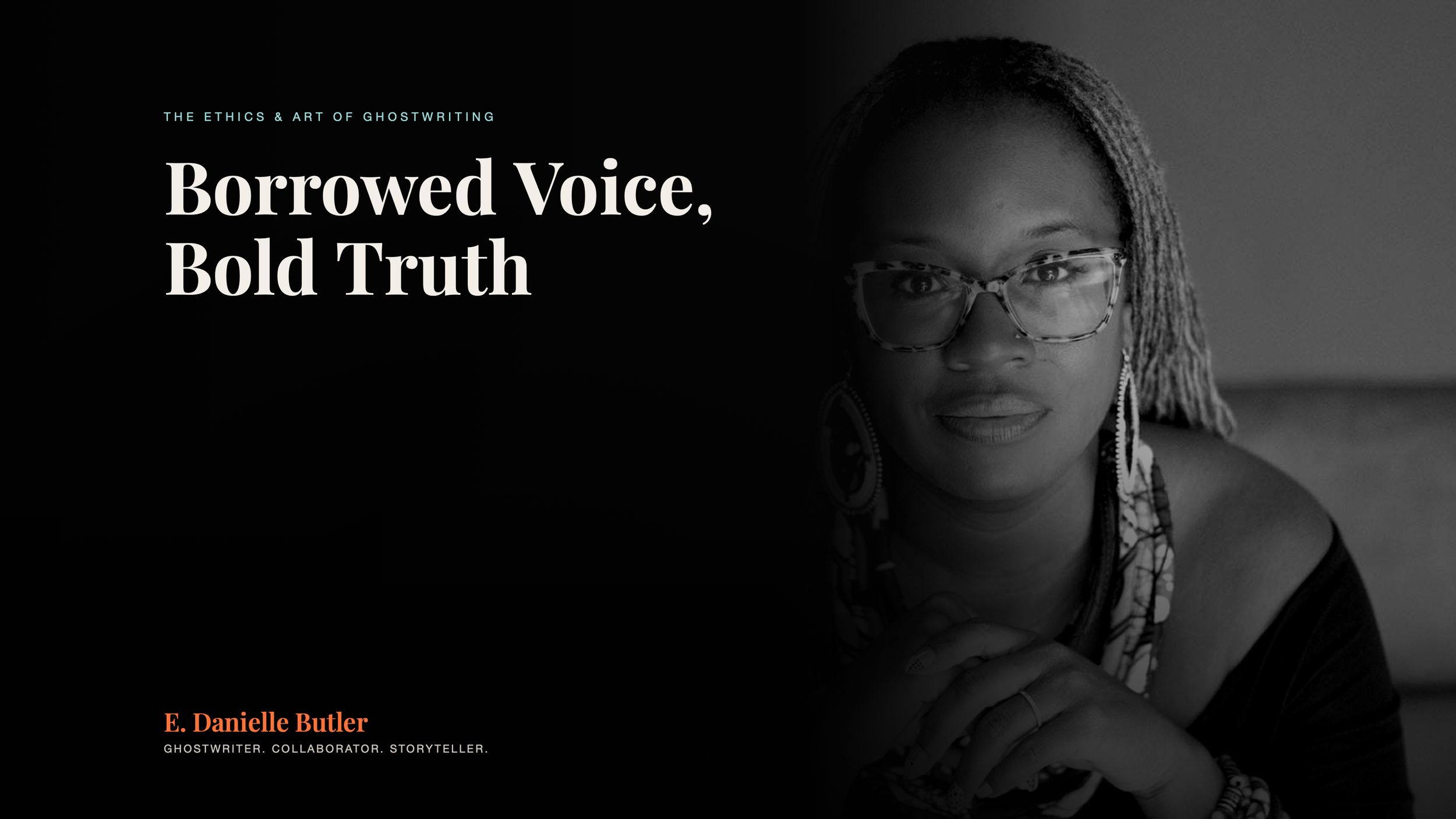
There's a strange math to good ghostwriting: the better I do my job, the less anyone knows I did it.
That's not a complaint. It's the opportunity. A ghostwriter's success is measured in invisibility — in how completely a reader believes the words on the page belong to the person whose name is on the cover. But invisibility isn't the same as absence. Something real happens in that space between a leader's story and the page it ends up on, and I've spent my career in that space. It's worth naming what actually happens there — the ghostwriting ethics behind it — instead of letting the paradox go unexamined.
I wrote about this same tension years ago in Permission to Write — on being the writer in the shadows. This piece picks up where that one left off.
What Theater Taught Me About Disappearing

E. Danielle Butler and Dr. Donald V. Prater performing at Atlanta Fringe Festival 2014
Long before I sat across from an author with a recorder running, I was on a stage learning how to disappear into someone else's truth.
Theater doesn't train you to erase yourself. It trains you to empty out your own agenda so someone else's can fill the space completely. It takes more of you, not less, to do that convincingly. You have to understand a character's fear, their logic, their rhythm of speech, well enough that your own instincts stop getting in the way.
Ghostwriting asks the same thing of me.
When I sit with a founder or a pastor or an executive, my job isn't to translate what they say into "better" language. It's to listen closely enough that I can write the sentence they would have written if they'd had the time, the training, and the distance from their own story to see it clearly. That's not translation. That's closer to acting — inhabiting a voice so fully that I’m not visible in it.
The Ethics Question: Whose Truth Is It?
Here's where the ghostwriting ethics get serious. If I can convincingly become someone else's voice, where's the line between shaping their story and quietly becoming its author?
I've spent years inside publishing and communications agencies watching how the best editorial teams draw that line, and it shaped how I work. The rule I hold myself to is simple to say and hard to practice: the story has to stay theirs at every decision point, not just at the signature. That means going back to a client with the hard question instead of quietly smoothing it over myself. It means flagging the sentence that sounds good but isn't quite true to what they said. Credit, authorship, and voice integrity aren't formalities; they're the whole ethical foundation the craft stands on. Lose that, and you're not a ghostwriter anymore. You're just a writer borrowing someone else's name.
The Faith Lens: Service as Craft
I don't think of disappearing into someone else's story as self-erasure. I think of it as service.
There's a faith-rooted way of holding someone else's story carefully — of believing that the work isn't really about you, even when you're the one doing the writing, and trusting the process before you can see its whole shape. That posture changes how the work feels day to day. It's not a performance of humility. It's the actual orientation: my name may never appear on the cover, and the work still matters. The work still matters to me because the person whose story it is deserves to have it told with the same care I'd want for my own.
The Opportunity
For years, I've brought this attention to other people's stories without turning it fully on my own, and it's taught me something worth passing on to you.
If you're a leader carrying a story you haven't told, here's what I've learned from the other side of that work: the story doesn't need you to have the polished, aspirational version ready. It needs the real one, the version built around the meetings and the setbacks and the parts of your life that don't make it into a highlight reel. That's the version worth hiring someone to help you tell, and it's the version a good ghostwriter is trained to find and protect.
Theater taught me to disappear into someone else's truth so it could be heard. Faith taught me to trust the process before I can see where it's going. Both are why I do this work the way I do — with the same care I'd want for my own story.
There's more to your story too. The question is whether you're ready to tell it with the attention it deserves.
Still weighing whether ghostwriting is right for your project? Here are 5 reasons to hire one for your next book.
If you're ready to tell yours with that same care, let's talk — schedule a consultation and let's find the version of your story only you can tell.